

An entrance says something before anyone knocks. The answer to “what does good iron gate design look like?” depends on the look you want and the job the gate needs to do: traditional scrollwork reads as classic and ornamental, while clean-lined steel gates and custom laser-cut patterns suit a more modern façade. The right choice starts with the entrance itself, then moves into privacy, opening mechanism, and the material and finish that match the site.
Ready to Start Your Next Project?
Get a free consultation and a detailed quote from EuroSys for Metal Industries. We handle design, fabrication and installation, from concept to handover.
This article walks through metal gate styles for homes and larger projects, from decorative to minimal, before getting into the practical side — material selection, steel gate design thickness, and the finishes that keep a gate looking sharp for years. Along the way, you’ll see how custom gate patterns can be cut to match a specific wall, fence, or architectural theme, giving every entrance a distinct identity rather than a generic off-the-shelf look.
What Iron Gate Design Styles Can You Choose?
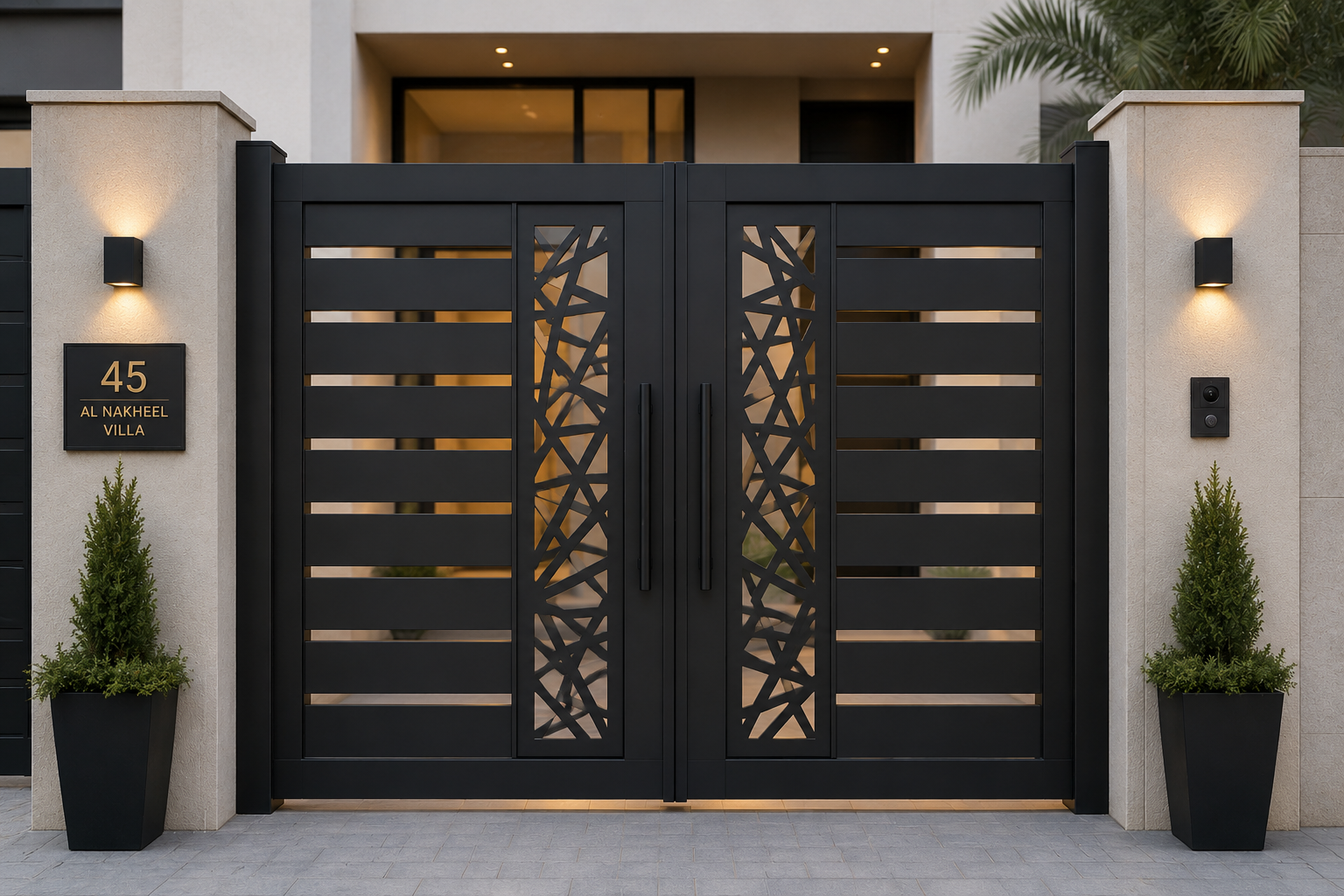 An iron gate design can range from a minimalist bar pattern to an intricately cut decorative screen, and the right choice depends on the surrounding architecture and the level of visual detail you want at the entrance. Iron gate styles generally fall into four recognizable categories, each with its own structural logic and finishing approach.
Modern gates with clean lines
Modern steel gates favor vertical or horizontal bars arranged in a geometric layout, with flat panels and little to no ornamental detailing. The look stays restrained, relying on proportion and spacing rather than decoration.
A straight-edged gate with evenly spaced vertical bars illustrates this style well, giving a clean, uncluttered appearance suited to contemporary buildings.
Traditional gates with scrollwork
Traditional ornamental gates bring in scrolls, floral motifs and shaped tops that give the structure a more classical character. This style is defined by its decorative detailing rather than a specific material, so a gate with scrollwork is not necessarily made from wrought iron.
An arched driveway gate featuring scrollwork along the panels is a typical visual example of this category.
Laser-cut gates with architectural patterns
Laser-cut gate patterns allow for geometric shapes, Islamic-inspired motifs or custom designs tied directly to a project’s architectural identity. Because the cutting process is precise, these patterns can repeat consistently across large gate surfaces.
A gate with a repeating cutout pattern that echoes details already present on the building façade works as a clear visual example, tying the entrance design to the structure behind it. The finish on these panels often pairs with coated steel, and reviewing the benefits of powder coating explains how this coating supports durability and appearance.
Mixed-frame gates with decorative panels
Mixed-frame gates combine a structural outer frame with an inset decorative panel, creating a visual distinction between the supporting element and the ornamental detail. This separation allows the frame to carry the gate’s structural load while the panel carries the design.
A simpler frame surrounding a patterned insert suits entrances where a less ornate, more balanced appearance is preferred over heavy detailing throughout.
Iron Gate Pattern Ideas for Different Entrances
Every entrance calls for a pattern suited to its scale, setting and the style of the building behind it. An effective iron gate design always reads as part of the entrance as a whole, not an isolated feature, which is why pattern choice depends on the façade, the fencing beside it and the entrance’s function.
Residential entrance patterns
For homes, the gate pattern should echo the façade and match the adjacent fence, since the entrance and boundary are read together.
- Contemporary homes: a restrained geometric pattern with clean lines and consistent spacing suits a minimalist façade without competing with it.
- Traditional façades: scrollwork patterns with flowing curves complement classic architectural details and give the entrance a more decorative character.
These front gate ideas work best when the chosen motif carries through to nearby fence panels, keeping the entrance visually unified.
Driveway gate layouts
Driveway gate design depends on whether the structure opens as two leaves or spans as one wide panel, since the pattern needs to read correctly in either configuration.
- Double-leaf gates: the pattern repeats across both leaves so the design appears continuous and balanced when the gate is closed.
- Single wide gates: the pattern extends uninterrupted across the full span, keeping the motif legible at a larger scale.
The relationship between the gate, the entrance columns and the surrounding wall also matters, as the pattern’s density and proportion should sit comfortably between these elements rather than clash with them.
Commercial and project entrance designs
Commercial and project entrances usually favor a custom metal gate that balances visual identity with practicality.
- Simple repeated patterns: geometric motifs repeated at regular intervals give a clean, consistent look suited to offices, facilities and public entrances.
- Custom architectural motifs: a bespoke pattern can reflect a project’s identity or branding while still fitting the entrance’s overall scale.
- Coordination with nearby panels: matching the gate’s pattern with adjacent decorative metal panels or fencing ties the entrance to the rest of the perimeter.
In these settings, the pattern’s role stays focused on appearance and visual coherence with the surrounding metalwork, rather than serving as a structural element on its own.
How Do Gate Shapes Change an Entrance?
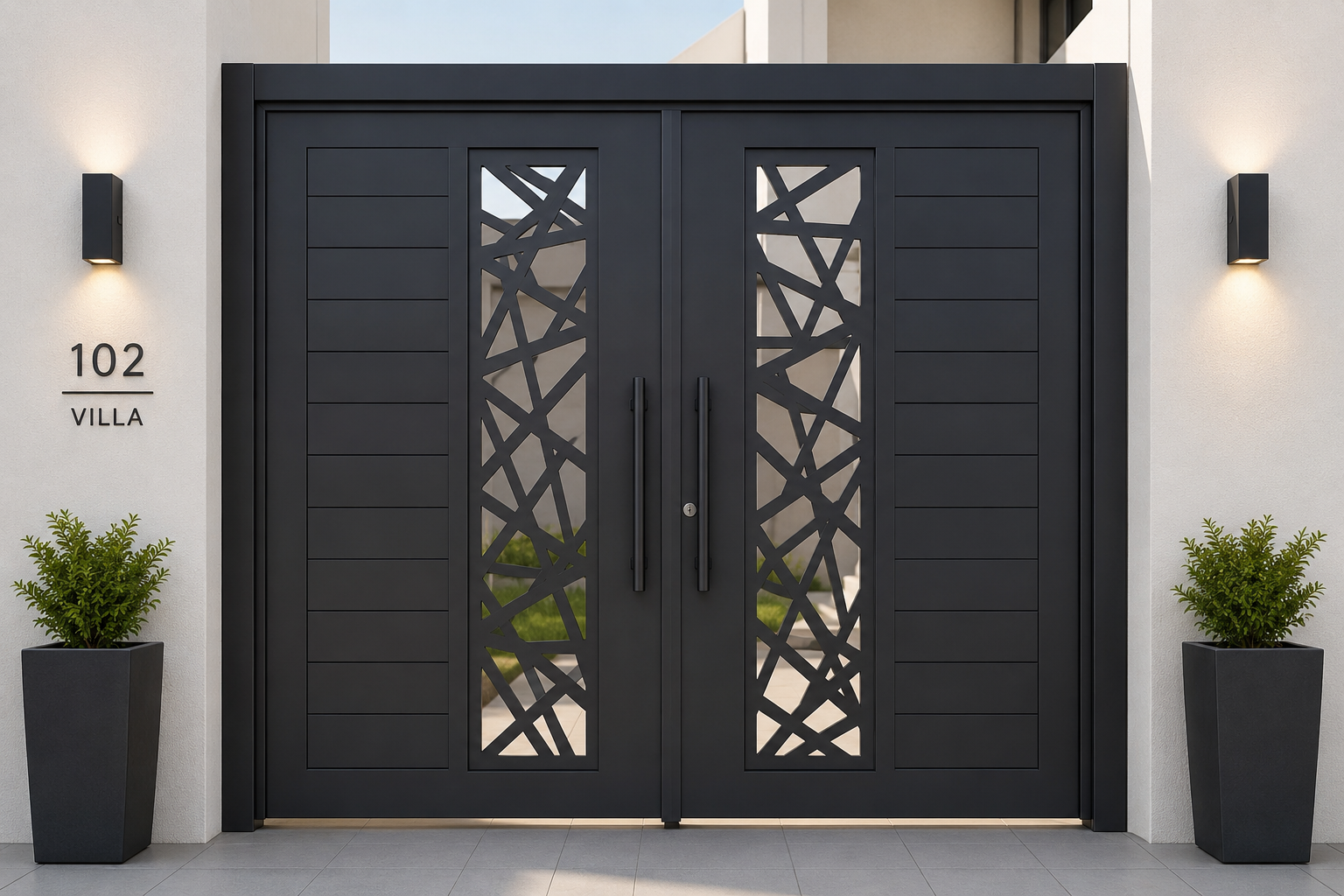 The shape of an iron gate design sets the tone for the whole entrance before anyone even reaches the door. A straight top reads as modern and orderly, while an arch or point adds height and a sense of formality, and the opening method itself—swing or sliding—shapes how the entrance functions on site.
Straight-top gate profiles
A level upper edge gives an entrance a clean, contemporary composition that pairs naturally with horizontal architectural lines such as flat rooflines, linear facades, or low garden walls. This profile tends to suit modern villas and commercial buildings where simplicity and symmetry matter more than ornamentation. A straight-top gate set against a horizontal wall creates a calm, balanced visual that doesn’t compete with the building’s existing lines.
Arched and pointed gate profiles
Curved and peaked tops introduce a different character, and the three common options each create a distinct impression. A single arch gives a soft, continuous curve that works well with entrances featuring rounded archways or classical columns. A double arch introduces rhythm and symmetry, often chosen for wider gates or facades with repeating architectural features. A pointed profile adds height and a more formal, upward-reaching silhouette, suited to entrances with taller columns or vertical detailing. None of these shapes fits every project equally — the right choice depends on how it relates to the surrounding facade rather than which one looks most elaborate.
Swing and sliding gate layouts
Beyond the top profile, the way a gate opens is a separate design decision with its own visual and practical effect. Swing gates use one or two hinged leaves that pivot open, giving a traditional look, while sliding gates move sideways along a track, offering a more streamlined appearance.
- Single-leaf swing: one panel hinges open on one side and needs clear space in its swing path in front of or behind the entrance.
- Double-leaf swing: two panels open from the center, often used for wider entrances, and need clear space in their swing paths in front of or behind the entrance.
- Sliding gate: the panel moves sideways rather than outward, which calls for enough lateral space along the wall or fence line for the gate to travel.
Choosing between swing and sliding isn’t only about appearance — it’s also a site decision based on the space available in front of, behind and beside the entrance.
Iron Gate Designs for Privacy and Openness
An iron gate design can sit anywhere on the scale between fully open and fully screened, depending on how the panel is built and where the openings are placed. Choosing between visibility and privacy usually comes down to three panel styles.
Open bars and mesh patterns
Bar spacing and orientation directly control how much can be seen through the gate. Wider gaps between bars allow a clear view in and out, while tighter spacing softens visibility without fully blocking it.
- Vertical bars: this layout suits entrances where an open, welcoming appearance is the goal, such as a main gate or a front access point where sightlines matter.
Solid and near-solid panels
Solid or near-solid panels create a screened, enclosed look that blocks sightlines almost completely. This option works well where privacy takes priority over visibility.
- Color coordination: matching the panel color with the surrounding fence or building façade keeps the gate looking integrated rather than added on.
Perforated and laser-cut panels
Laser-cut and perforated panels sit between fully open and fully solid designs. The size and placement of each opening determine how much screening the panel provides, so the same technique can be adjusted for different levels of privacy.
- Denser pattern at eye level: this placement idea increases screening exactly where sightlines are most direct.
- More open pattern elsewhere: lighter perforation above or below eye level keeps the design from feeling heavy, while staying subject to project review before confirming the final layout.
Panel style, gate size, supporting structure, and site conditions all need to be reviewed together before fabrication begins, since no single opening ratio works across every project or location.
Custom Laser-Cut Panels for Gate Designs
Laser-cut panels bring an added decorative dimension to iron gate design, allowing patterns, motifs, and geometric cutouts to be integrated directly into the gate structure. These panels can be adapted to match the overall frame, fencing, or facade surrounding the gate, creating a cohesive visual identity across the project.
Laser Cutting Services for Metal
Laser cutting services for metal allow precise shaping of panels used in gates, fences, columns, and similar architectural elements. The process works with different metal thicknesses and specifications depending on the intended use and structural requirements of the project, similar to the approach used for laser-cut decorative facades.
When requesting a quote for a gate panel project, it helps to provide the following details:
- Pattern: describe the intended design or motif to be cut into the panel, along with how it should visually relate to the surrounding frame or fence.
- Material: specify the type of metal panel being considered for the gate.
- Dimensions: confirm the exact size of the panel required for the gate opening or frame.
- Thickness: state the material thickness suited to the gate’s structural and visual needs.
- Specifications: outline any available technical requirements relevant to the project.
- Cutout suitability: confirm whether the proposed cutout design is appropriate for the panel material and intended application before finalizing the order.
Recommended products from EuroSys
For those designing an iron gate and needing precision-cut panels or decorative components, EuroSys store offers manufacturing support that goes beyond standard fabrication. The store handles everything from design and manufacturing to supply and installation, drawing on experience since 2013 and a production facility equipped for cutting, welding, forming, and assembly. Among its notable offerings is laser cutting, a process suited for turning gate concepts into accurately cut metal pieces. Reach out to the team for a quote or technical consultation tailored to your project.
Laser Cutting Services for Iron and Metals
This service delivers custom laser cutting for iron, steel, stainless steel, and aluminum sheets and plates, making it a practical fit for anyone refining an iron gate design that calls for sharp lines or intricate patterns. Designs are first prepared using specialized software, then cut with laser precision to match the intended shapes.
- Application: the service suits custom metal components and decorative panels used in architectural and industrial projects, including gates, fencing elements, and ornamental features.
- Process: each cutting job starts from a prepared design file, ensuring that curves, perforations, and geometric patterns are reproduced accurately on the material.
- Materials: iron and steel, stainless steel, and aluminum sheets or plates can all be processed through this cutting service.
Dimensions, material thicknesses, and other specifications depend on the project, so confirm these details when requesting a quote for Laser Cutting Services for Metal.
Frequently Asked Questions About Iron Gate Design
Here are direct answers to common questions about iron gate design.
Which gate is better, steel or iron?
Neither material is universally preferable. The right choice depends on the specified material, desired appearance, fabrication method, finish and site requirements; a wrought-iron look alone does not confirm the actual material used.
What is the latest design for iron gates?
Contemporary gate designs favor clean geometric lines, simple panels and customized laser-cut patterns. The right style should match the building rather than assuming one design suits every entrance.
What is the price of a 100 kg iron gate?
Weight alone cannot determine a gate’s price. Dimensions, material, pattern complexity, finish, hardware and installation requirements all factor into the cost, so it’s best to request a project-specific quote.
How to construct an iron gate?
Construction begins with developing the layout and measurements, then specifying the material and frame. The pattern and opening method are planned next, followed by fabrication, finishing and installation according to the approved project requirements.
Ready to Start Your Next Project?
Get a free consultation and a detailed quote from EuroSys for Metal Industries. We handle design, fabrication and installation, from concept to handover.
An effective iron gate design starts with choosing a style and pattern that suits the entrance, then builds in privacy, opening layout, material grade, and finish to match the project’s functional and aesthetic needs. These elements work together, not separately, to deliver a gate that performs well and looks right in its setting. If you have a custom pattern in mind, reach out to the EuroSys store for a project-specific quote or technical consultation.
Read also