

When comparing powder coating vs wet paint for architectural steel, neither option is universally better. Powder coating is often suited to transportable steel components that can be properly prepared and cured in a controlled oven, while wet paint is generally more practical for large, fixed, or on-site structures that need primers, several protective coats, or localized repairs.
Ready to Start Your Next Project?
Get a free consultation and a detailed quote from EuroSys for Metal Industries. We handle design, fabrication and installation, from concept to handover.
The right architectural steel coating depends on required durability, corrosion exposure, appearance, project scale, installation conditions, curing access, and future repair needs. Heat, dust, humidity, salt, chemicals, and sunlight in Saudi Arabia can also influence the choice between these steel finishing options. This comparison considers powder coating versus wet paint as protective coating systems for steel, not as guaranteed lifetime or maintenance-free finishes.
Which service can support projects?
What does the service include?
Professional Road Planning Services provides road planning and traffic line painting for projects in Saudi Arabia. The work uses reflective, durable materials and is carried out in line with approved specifications and public safety requirements.
The service supports roads, pavements, highways, parking lots, and industrial areas. It includes surface cleaning and preparation before the selected marking system is applied.
- Painting methods: Available options include cold painting and thermoplastic painting.
- Quality control: Checks are performed to support consistent application and alignment with project requirements.
- Related capabilities: The listed services also include tensile shades, structural canopies, decorative laser-cut panels, powder coating services, steel structures, and laser cutting services.
- Scope clarification: For powder coating vs wet paint considerations, this service is primarily focused on road marking and traffic line painting, not a direct substitute for a complete architectural-steel coating specification.
How do the systems work?
How is powder applied?
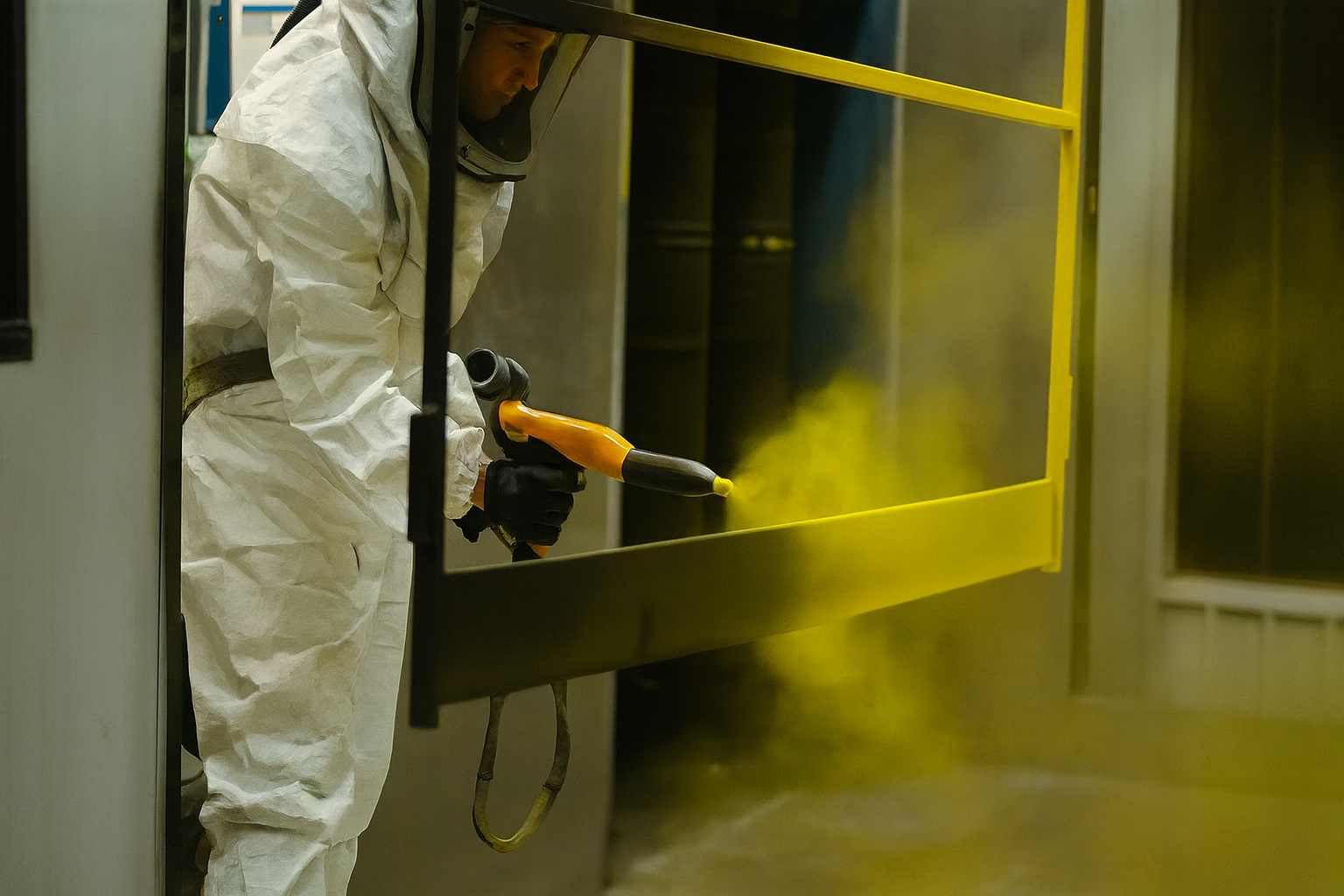
In powder coating vs wet paint, powder coating uses dry particles applied through electrostatic powder application. The particles are electrically charged and sprayed onto a cleaned, grounded steel surface, where they adhere before heating.
- The steel surface is cleaned and prepared.
- Dry powder particles receive an electrical charge.
- The charged powder is sprayed onto the grounded steel component.
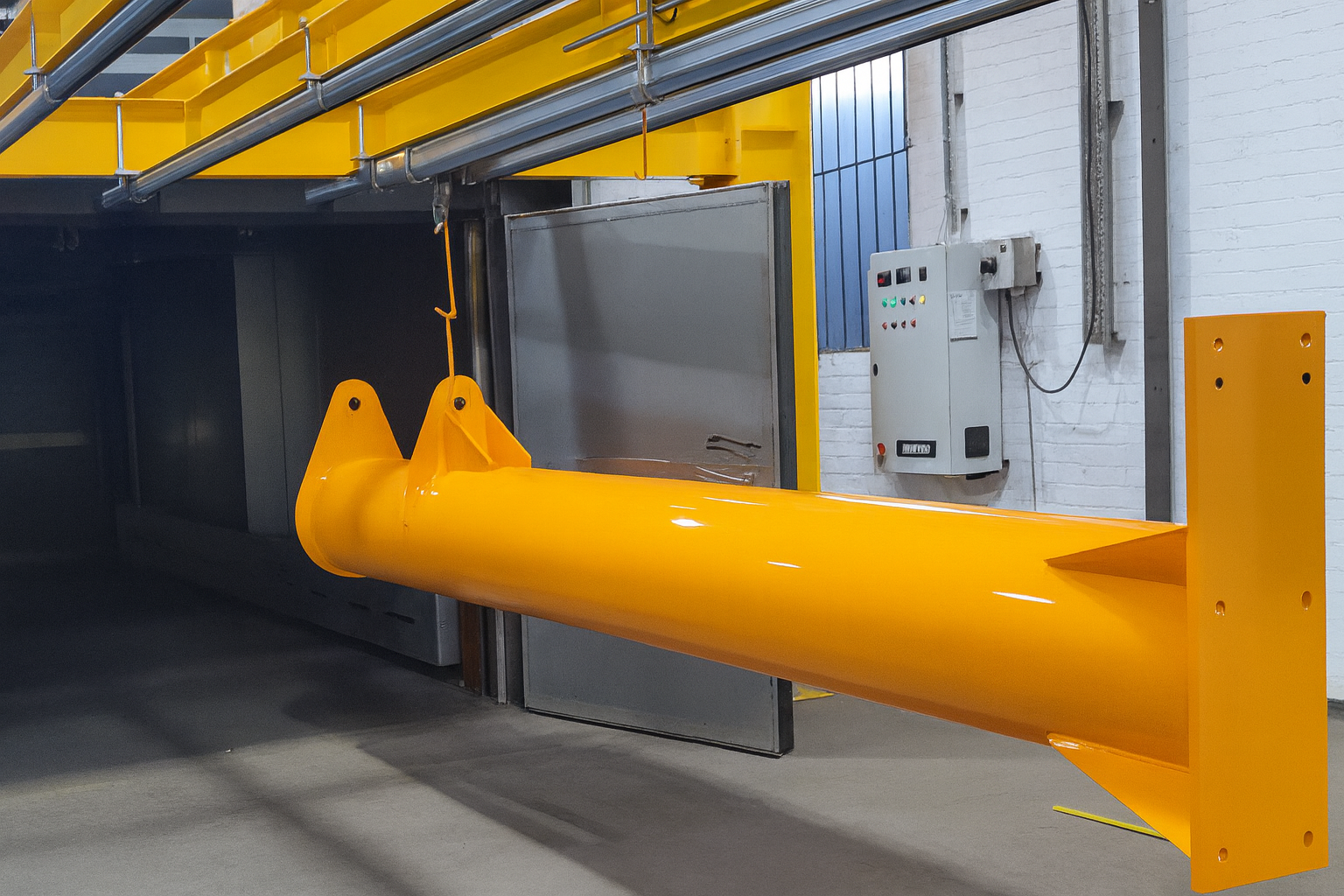
- The coated component is placed in an oven for oven curing.
Powder application can provide relatively uniform coverage in a controlled production line. However, the component must fit inside the oven and tolerate the required curing temperature.
How is wet paint applied?
Wet paint is applied using liquid spray painting, brushing, rolling, or other suitable methods. It contains a liquid carrier, such as solvent or water, which allows the coating to be applied to the steel surface.
- The steel surface is prepared for coating.
- A steel primer may be applied where required.
- One or more intermediate coats can be added according to the corrosion environment and performance specification.
- A final topcoat is applied to complete the wet-paint system.
- The coating film forms as the liquid carrier evaporates, reacts chemically, or undergoes forced drying.
Wet paint offers greater flexibility for large, fixed, complex, or already-installed structures. This makes it suitable for on-site coating where moving the component into an oven is not practical.
What does curing involve?
Curing is the stage in which the applied coating develops into a continuous film. For powder coating, heating melts the particles and allows the resin to form a bonded film on the steel.
Actual oven curing conditions depend on the powder formulation, steel thickness, part geometry, and the manufacturer’s requirements. Wet paint forms its film through evaporation, chemical reaction, forced drying, or a combination of these processes.
Which finish performs better?
Which option resists damage?
In the comparison of powder coating vs wet paint, powder coating commonly forms a harder, thicker film that can resist scratching, abrasion, and everyday impact well. This depends on properly controlled surface preparation, coating chemistry, film thickness, and curing.
Wet paint can also deliver strong durability when it is specified as a complete primer-and-topcoat system suited to the intended exposure environment. Its resistance should be assessed across the full coating system, not the topcoat alone.
- Powder coating: It commonly provides a relatively hard, thicker film with good resistance to scratches, abrasion, and routine impact.
- Wet paint: It can offer strong protection when the primer and topcoat are selected together for the exposure conditions.
- Both finishes: Their damage resistance depends on preparation quality, coating selection, application, and film thickness.
How does corrosion protection differ?
Neither powder coating nor wet paint automatically prevents corrosion. Corrosion may begin beneath or around either finish when deep scratches, exposed edges, weld areas, trapped water, contaminants, or poor adhesion are present.
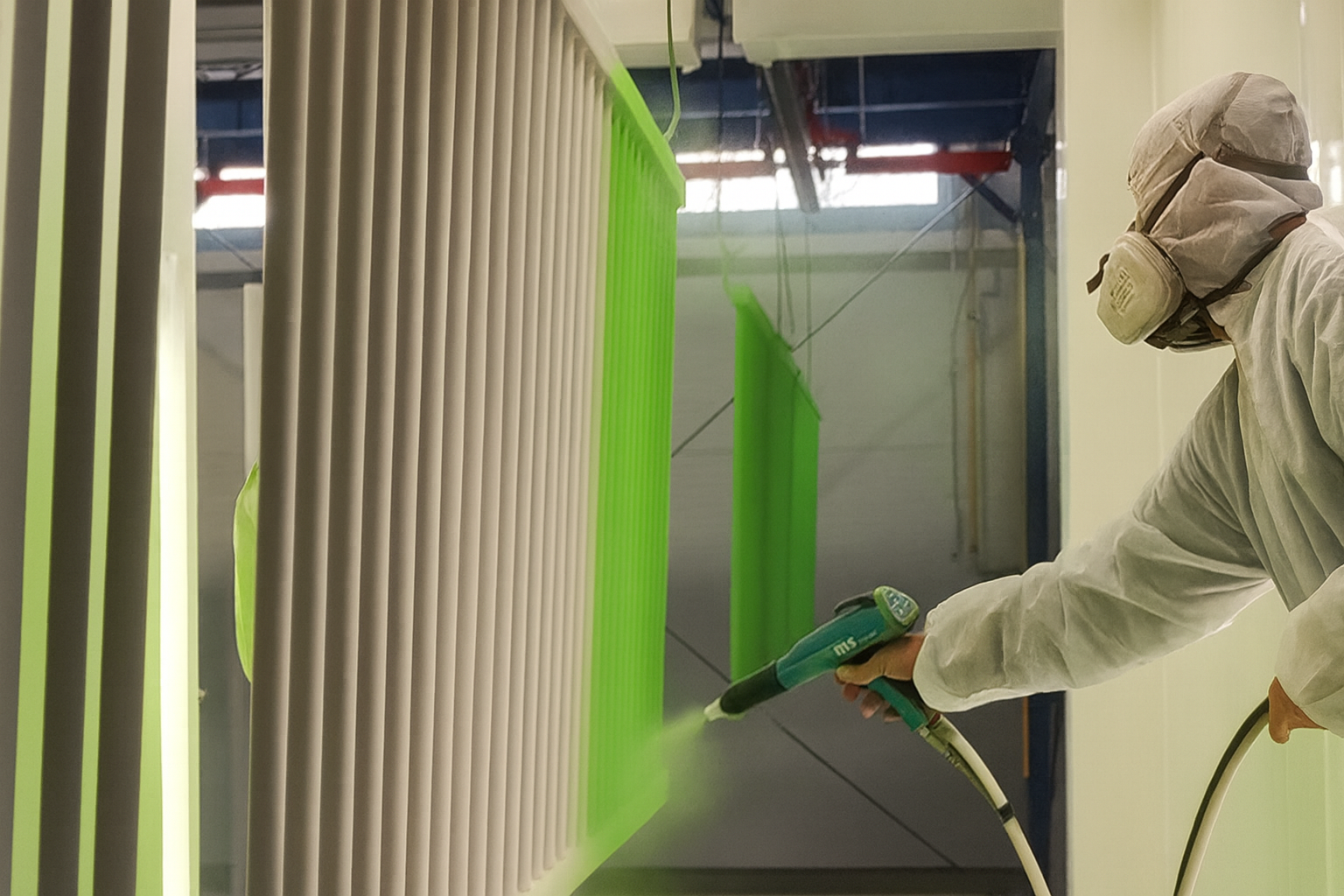
Effective corrosion protection starts with a clean, sound surface and a coating system appropriate for the steel condition and exposure environment.
- Remove contaminants: Oil, grease, salts, dust, loose rust, mill scale, and old unsound coatings must be removed.
- Prepare the surface: Preparation may involve solvent cleaning, mechanical cleaning, abrasive blasting, chemical treatment, or an appropriate primer.
- Treat vulnerable areas: Edges, welds, and areas where water can collect need suitable attention.
- Maintain adhesion: Proper preparation and application help reduce the risk of corrosion spreading beneath the coating.
What affects outdoor durability?
Outdoor durability depends on more than whether a surface uses powder coating or wet paint. Resin and pigment type, coating thickness, surface preparation, part design, drainage, edge and weld treatment, sunlight, dust, humidity, salt exposure, chemicals, and maintenance all affect performance.
Architectural specifications should define the required performance class and exposure conditions instead of relying only on terms such as outdoor paint, rust-resistant coating, or durable finish. Neither technology has a fixed service life or always lasts longer, as results vary by product, preparation, application quality, environment, and maintenance.
What does each option cost?
The total coating cost should be compared across the full project, not by looking only at the initial coating price. Preparation, application requirements, future repairs, and expected maintenance cost can all change the final figure.
| Cost factor | Powder coating | Wet paint | |—|—|—| | Suitable project type | It may be cost-effective for repeatable production of transportable components. | It may be more economical for large steel assemblies, on-site work, phased construction, or projects needing several protective layers. | | Application-related costs | Costs can be controlled where application is repeatable and overspray can be managed or recovered. | Labor, access equipment, weather protection, drying time, and recoat intervals can have a major effect on costs. | | Handling requirements | Special handling, masking, disassembly, transport, and oven access can increase costs. | Site access and working conditions can increase steel painting cost, particularly for large or complex assemblies. | | Future work | Inspection, touch-ups, repairs, and expected maintenance should be included in the lifecycle cost. | Inspection, touch-ups, future repairs, and maintenance requirements should also be included in the lifecycle cost. |
Powder coating cost factors: Powder coating can offer controlled application for repeatable parts that can be transported and processed in an oven. The cost may rise when components need masking, disassembly, special handling, or transport before oven processing.
Wet paint costs: Wet paint can suit projects that cannot be easily moved, including large steel structures and work completed in stages. The final cost depends heavily on labor, site access, weather protection, drying periods, and the time required between coats.
When comparing powder coating vs wet paint, include preparation, masking, transportation, oven processing, primer, the number of coats, labor, inspection, touch-ups, future repairs, and anticipated maintenance. Avoid fixed savings percentages or universal lifecycle-cost claims, as costs vary with project size, part geometry, location, coating specification, and labor conditions.
Where does each finish fit?
When is powder coating suitable?
Powder coating is suitable for architectural metal parts that can be transported and cured inside a controlled oven. It supports a consistent factory finish with defined colour and texture, while offering resistance to routine scratching and abrasion.
Examples include laser-cut decorative panels, metal cladding, fabricated canopy components, brackets, enclosures, and similar fabricated architectural elements.
When is wet paint preferable?
Wet paint is preferable for very large steel structures, fixed or assembled components, phased construction, and existing steel that cannot be moved or heated in an oven. In powder coating vs wet paint decisions, this makes wet paint more practical where treatment must take place after installation.
It also allows tailored primer and multi-coat systems, localised touch-ups, and repainting of installed sections without reprocessing the entire assembly. Examples include large structural steelwork and installed metal areas requiring repairs or staged coating work.
What about Saudi exposure?
For exposed architectural steel in Saudi Arabia, the coating system should be assessed against direct sun, high temperatures, airborne dust, humidity, coastal salt, chemical exposure, drainage, and future maintenance needs.
- Coastal or highly corrosive locations: Specify the complete corrosion-protection system and required performance level rather than choosing powder coating or wet paint based on appearance alone.
- Large or installed structures: Confirm access, surface preparation conditions, weather controls, curing time, and repair procedures before approving wet paint or another coating option.
What should the specification include?
A coating specification should define the steel substrate, its existing condition, the required surface-cleanliness level, surface profile where applicable, preparation method, coating type, primer, number of coats, target film thickness, color, gloss, texture, curing requirements, repair method, and inspection procedure.
Generic color names or coating labels do not demonstrate performance. The specification should require the product data sheet and project-specific performance requirements for powder coating vs wet paint.
How should the steel be prepared?
Steel preparation should match the substrate condition and the required coating system. Design details should also limit water retention and provide access for preparation, particularly around edges, welds, crevices, internal cavities, drainage points, and areas exposed to impact or abrasion.
- Steel substrate: Identify the steel type and its existing surface condition.
- Surface cleanliness: State the required level of surface cleanliness before coating.
- Surface profile: Specify the required profile where the coating system requires one.
- Preparation method: Define how the steel must be prepared before the coating is applied.
- Design access: Ensure edges, welds, cavities, and drainage areas can be prepared effectively.
- Vulnerable areas: Identify locations likely to experience impact or abrasion.
Which coating details matter?
The coating details should state the complete system rather than relying on a general coating name. Requirements differ between powder coating and wet paint, particularly in processing conditions and application controls.
- Coating system: Specify the coating type, primer, number of coats, and target film thickness.
- Appearance: Define the required color, gloss level, and texture.
- Curing: State the curing requirements and any relevant drying conditions.
- Powder coating: Confirm part dimensions, oven capacity, masking needs, grounding, curing schedule, coating compatibility, and whether the assembled component can be processed without damaging adjacent materials.
- Wet paint: Confirm ambient temperature, steel temperature, humidity, dew-point conditions, ventilation, overspray control, recoat windows, drying or curing requirements, and protection from dust or moisture.
- Repairs: Define the approved repair method for damaged or incomplete coating areas.
How can quality be verified?
Ready to Start Your Next Project?
Get a free consultation and a detailed quote from EuroSys for Metal Industries. We handle design, fabrication and installation, from concept to handover.
Quality verification should confirm that the finished coating meets the specified system, appearance, coverage, and performance requirements. The inspection procedure should also confirm that any repairs use the approved coating system.
- Visual inspection: Check the coated surface for visible defects.
- Film thickness: Measure film thickness against the specified target.
- Adhesion: Carry out adhesion assessment where it is specified.
- Color and gloss: Verify that color and gloss meet the defined requirements.
- Edges and welds: Inspect coverage at edges, welds, and other difficult areas.
- Defect inspection: Check for coating defects and incomplete coverage.
- Repair confirmation: Verify that repairs follow the approved system.
Which questions do buyers ask?
Which is better, powder coating or paint?
In powder coating vs wet paint, powder coating is often better for transportable steel parts that need a controlled, hard finish. A properly specified wet-paint system is often more suitable for large, fixed, on-site, or multi-layer corrosion-protection projects.
What are the negatives of powder coating?
Powder coating requires suitable oven access, controlled curing, transportable part dimensions, and careful repair procedures. It may be impractical for oversized or already-installed steel, and failures can occur when preparation, edges, welds, or impact damage are neglected.
What lasts longer, paint or powder coat?
Neither paint nor powder coat lasts longer in every situation. Service life depends on the resin or paint system, surface preparation, film thickness, exposure environment, design details, application quality, inspection, and maintenance.
What type of paint is equivalent to powder coating?
There is no universal one-to-one paint equivalent to powder coating. A high-performance industrial liquid system with the appropriate primer, intermediate coats, topcoat, film thickness, and environmental rating may provide comparable protection when correctly specified
Related Articles: