

Choosing the correct road marking material affects visibility, safety, maintenance frequency, and the total cost of a project. Two of the most widely used options are thermoplastic road markings and cold paint. Although both materials can create lines, arrows, symbols, parking bays, and traffic-control markings, their application methods and long-term performance differ.
Ready to Start Your Next Project?
Get a free consultation and a detailed quote from EuroSys for Metal Industries. We handle design, fabrication and installation, from concept to handover.
A practical thermoplastic vs cold paint road marking comparison should consider more than the initial price. Traffic volume, pavement condition, project duration, curing time, expected lifespan, and maintenance requirements all influence which option offers better value.
EuroSys provides professional road marking services in Saudi Arabia, including cold paint and thermoplastic applications for highways, parking areas, industrial zones, and commercial projects.
What Is Thermoplastic Road Marking?
Thermoplastic road marking is applied as a heated material that bonds to a properly prepared pavement surface. After application, it cools and forms a solid, durable marking layer.
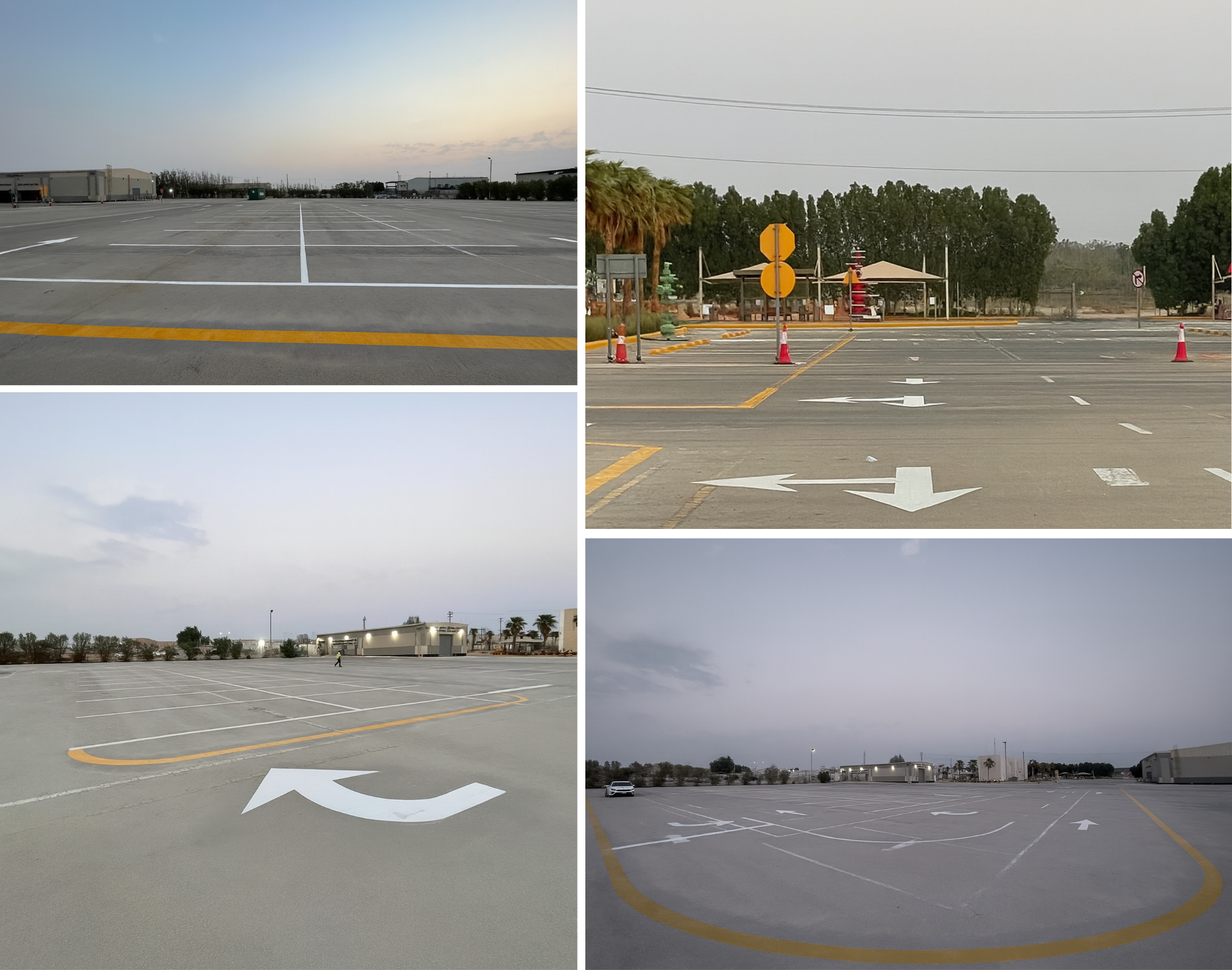
Because thermoplastic markings generally create a thicker layer than conventional cold paint, they are commonly considered for roads and sites exposed to frequent vehicle movement.
Thermoplastic road marking can be used for:
- Highway lane lines
- Road-edge lines
- Directional arrows
- Stop and yield markings
- Pedestrian crossings
- Intersections and junctions
- Industrial access roads
- Busy parking facilities
- Traffic islands and hatched zones
- Numbers, letters, and pavement symbols
The final performance depends on surface preparation, pavement compatibility, application thickness, temperature control, workmanship, traffic conditions, and the project’s technical specifications.
What Is Cold Paint Road Marking?
Cold paint is a liquid marking material applied without the heating process required for thermoplastic systems. It offers a relatively simple and efficient application method for many road, parking, commercial, and industrial projects.
Cold paint road marking is commonly used for:
- Parking spaces
- Residential developments
- Internal roads
- Industrial yards
- Warehouses
- Temporary traffic arrangements
- Low- and moderate-traffic areas
- Maintenance and remarking works
- Loading zones
- Pedestrian and operational areas
Different cold-paint systems may have different compositions and performance characteristics. Therefore, the contractor must confirm that the selected product is suitable for the surface, traffic level, environmental exposure, and required service life.
Thermoplastic vs Cold Paint Road Marking Comparison
The following table summarizes the main differences between the two systems.
| Comparison factor | Thermoplastic road marking | Cold paint road marking |
|---|---|---|
| Application method | Material is heated before application | Applied as a liquid without thermoplastic heating |
| Initial cost | Generally higher | Generally lower |
| Marking thickness | Usually creates a thicker layer | Usually creates a thinner coating |
| Durability | Often better for heavy or frequent traffic | More suitable for low- or moderate-traffic applications |
| Application speed | Requires heating equipment and controlled application | Usually simpler and faster to mobilize |
| Drying or setting | Cools and sets after application | Requires the specified drying or curing period |
| Maintenance frequency | May require less frequent renewal under suitable conditions | May require more frequent repainting |
| Typical applications | Highways, main roads, busy intersections and industrial routes | Parking areas, internal roads, warehouses and temporary markings |
| Equipment requirements | Specialized heating and application equipment | Relatively simpler application equipment |
| Removal or layout changes | Can be more difficult to modify or remove | Often more practical for temporary or changing layouts |
| Long-term value | Can provide better lifecycle value in high-traffic areas | Can be more economical for low-traffic or short-term projects |
These are general differences rather than fixed rules. The result of any thermoplastic vs cold paint road marking assessment depends on the product specification, pavement condition, application quality, site environment, and level of use.
Thermoplastic vs Cold Paint Road Marking Cost
Cold paint usually has a lower initial application cost. Its simpler application process and equipment requirements can make it suitable for projects with restricted budgets, short operating periods, or limited traffic.
Thermoplastic marking generally has a higher upfront cost because it requires specialized materials, heating equipment, trained operators, and careful application control. However, the initial quotation does not provide a complete picture of the project’s value.
The total cost should include:
- Material supply
- Surface preparation
- Labour requirements
- Machinery and equipment
- Traffic-control arrangements
- Application thickness
- Number and complexity of symbols
- Project size and location
- Drying or cooling time
- Expected maintenance frequency
- Repainting or replacement costs
- Operational disruption during maintenance
For a busy road, the longer potential service life of thermoplastic markings may compensate for the higher initial investment. In a private parking area with limited traffic, cold paint may provide the necessary performance at a more appropriate cost.
For this reason, project owners should compare lifecycle costs instead of selecting a system solely according to the lowest price per square metre or linear metre.
Which Road Marking Material Is More Durable?
Thermoplastic road markings are generally expected to provide greater durability in areas exposed to continuous or heavy traffic. Their thicker application can help them withstand regular vehicle movement when the material is correctly specified and installed.
Cold paint creates a thinner layer and may wear more quickly in high-traffic locations. However, it can still provide effective performance in parking areas, private developments, warehouses, internal roads, and other locations with lower traffic intensity.
Durability is affected by several factors.
Traffic Volume
A highway, logistics yard, or industrial route used by heavy vehicles creates more mechanical wear than a residential parking area. The marking system must reflect the expected number and type of vehicles.
Pavement Condition
Cracks, loose materials, contamination, or deteriorated pavement can reduce the performance of both thermoplastic and cold paint. Applying new markings over an unsuitable surface may lead to early failure.
Surface Preparation
Dust, moisture, oil, debris, and existing loose coatings can prevent proper adhesion. EuroSys includes cleaning and surface preparation as the first stage of its road marking implementation process.
Application Quality
Correct measurements, material mixing, temperature control, equipment adjustment, and application thickness all affect the finished result.
Environmental Exposure
Heat, dust, sunlight, moisture, and surface-temperature changes can influence road marking performance. Materials should be selected according to the conditions expected at the project location.
Vehicle Type
Heavy trucks, forklifts, buses, and industrial equipment can create greater wear than passenger vehicles. Turning, braking, and acceleration zones may also deteriorate faster than straight sections.
Maintenance Practices
Regular inspections allow worn or damaged markings to be identified before visibility declines significantly. Planned maintenance can preserve site organization and safety.
Initial Cost vs Lifecycle Cost
The lowest initial cost is not always the lowest total cost.
Suppose cold paint needs to be renewed more frequently on a heavily used road. Each renewal may involve new material, labour, machinery, traffic management, and temporary disruption. Over several maintenance cycles, the accumulated cost could exceed the cost of a more durable system.
Thermoplastic road marking may require a larger initial budget but can reduce the frequency of remarking in suitable applications. This can be particularly valuable where closing lanes or restricting access is difficult.
A lifecycle assessment should answer four questions:
- How much does the initial application cost?
- How long is the marking expected to perform under the site’s conditions?
- How frequently will inspection and maintenance be required?
- What operational costs will arise whenever the markings are renewed?
This approach produces a more realistic thermoplastic vs cold paint road marking cost comparison.
When Should You Choose Thermoplastic Road Marking?
Thermoplastic may be the more suitable option when:
- The road carries frequent or heavy traffic
- Long-term durability is a priority
- The project involves highways or main access roads
- Markings will be exposed to trucks or industrial vehicles
- Repeated road closures would be disruptive
- The project specification requires a thicker marking system
- Longer maintenance intervals are preferred
- High-use junctions, crossings, or turning areas require durable markings
EuroSys has delivered thermoplastic marking works for projects in different regions of Saudi Arabia. Examples presented in the company’s portfolio include work associated with Saudi Aramco, the Red Sea Project, Nubco, and other infrastructure and industrial developments.
When Should You Choose Cold Paint Road Marking?
Cold paint may be more appropriate when:
- The site has low or moderate traffic
- The initial budget is a primary consideration
- The markings are temporary
- The layout may change in the future
- The project involves an internal road or private parking area
- Fast and straightforward mobilization is required
- Regular repainting can be completed without major disruption
- The application is inside a warehouse or controlled facility
Cold paint is not limited to parking spaces. When correctly specified and applied, it can support a variety of road planning, industrial, and commercial applications.
Choosing a Material for Parking Areas
Parking facilities have different requirements depending on their size and usage.
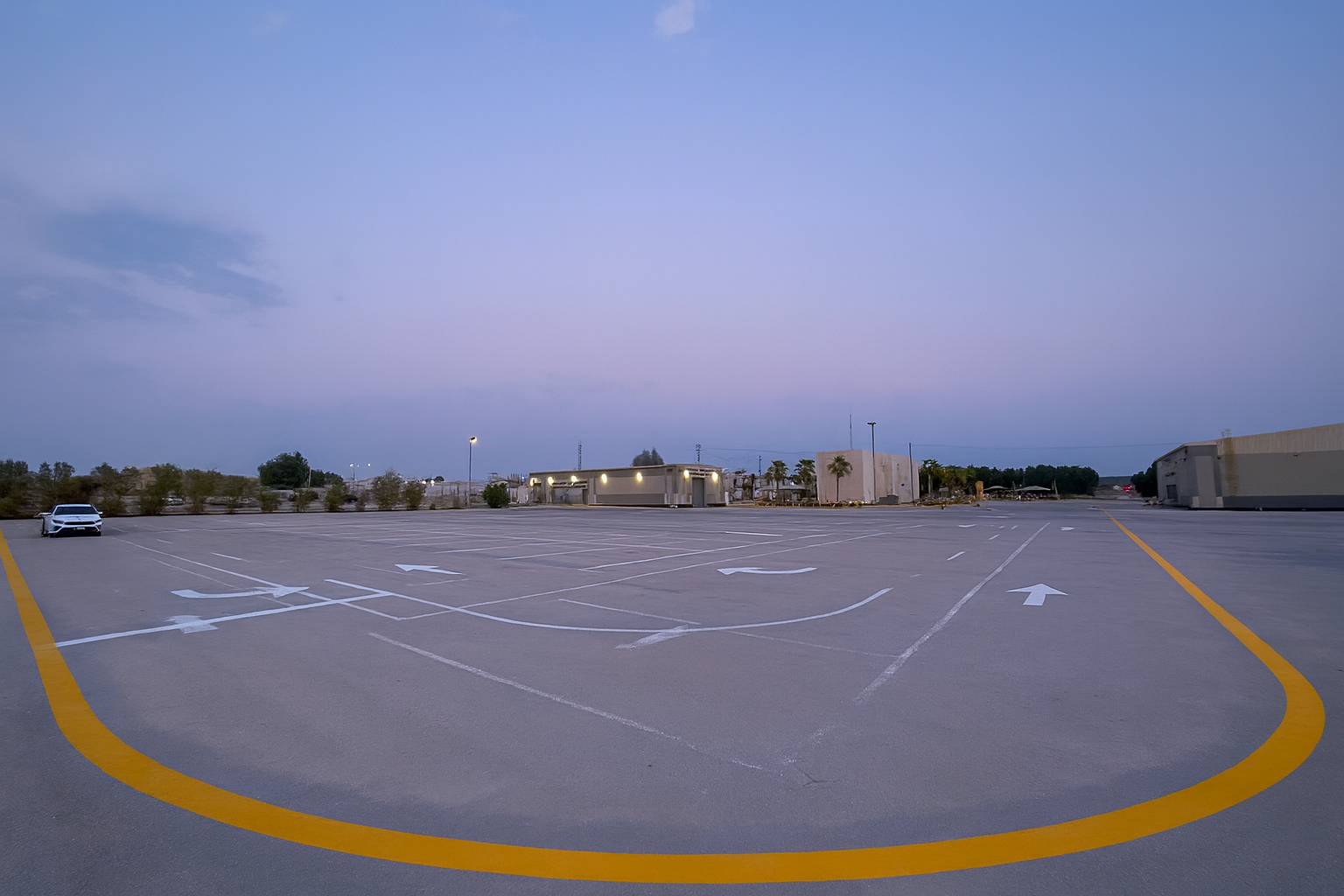
Cold paint may be sufficient for:
- Small residential parking areas
- Staff parking
- Lightly used private facilities
- Numbered parking bays
- Temporary layouts
- Indoor or controlled environments
Thermoplastic may be considered for:
- Shopping centre parking areas
- Transport facilities
- Hospital parking zones
- Large public parking areas
- Industrial employee parking
- Busy entrances and exits
- High-use directional routes
A single parking project can also use different marking systems in different areas. High-traffic access lanes may require a more durable solution, while individual bays may be completed using a more economical system.
EuroSys also provides shades and fences that can be coordinated with road markings to create organized parking solutions for residential, commercial, and industrial projects.
Road Marking for Industrial and Logistics Sites
Industrial facilities require careful evaluation because road markings may be exposed to trucks, forklifts, equipment, frequent turning movements, and operational chemicals or contaminants.
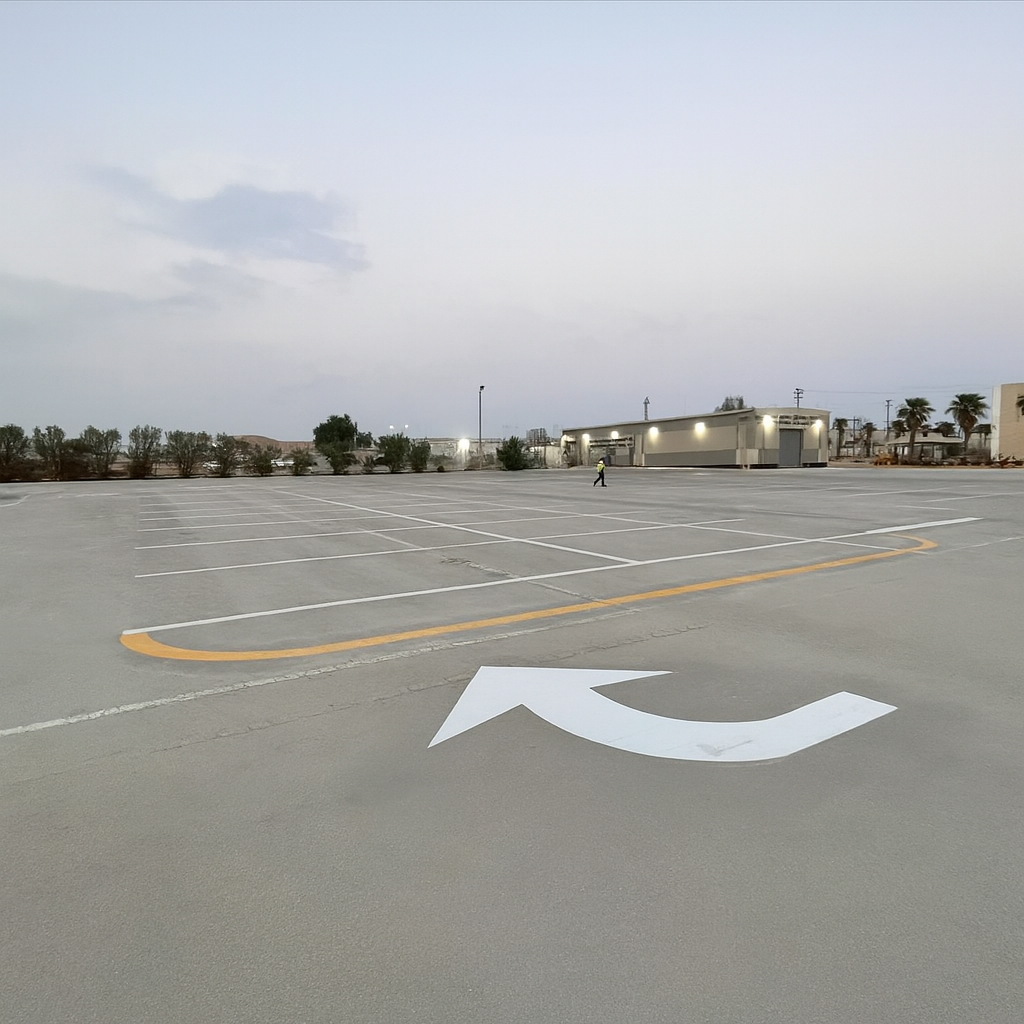
Typical industrial markings include:
- Truck routes
- Forklift lanes
- Pedestrian walkways
- Loading-bay boundaries
- Storage zones
- Restricted areas
- Equipment locations
- Emergency access routes
- Parking and waiting zones
- Directional arrows and safety symbols
Thermoplastic may be considered for external routes with frequent heavy-vehicle movement. Cold paint may be selected for internal areas, operational zones, or locations where layouts are likely to change.
The choice should be based on the conditions within each section rather than applying one material throughout the entire facility without assessment.
Why Surface Preparation Matters for Both Materials
Neither thermoplastic nor cold paint can compensate for poor surface preparation. A professional contractor must inspect and prepare the application area before marking begins.
The process may include:
- Inspecting the pavement and existing markings.
- Identifying dust, oil, moisture, or loose materials.
- Cleaning the surface thoroughly.
- Removing unstable or incompatible coatings when required.
- Repairing or reporting surface defects that could affect the result.
- Measuring and setting out the approved layout.
- Confirming suitable application conditions.
- Protecting the work area from vehicles and pedestrians.
After application, the contractor should inspect line alignment, dimensions, coverage, consistency, symbols, and overall finish.
Common Mistakes When Selecting Road Marking Materials
Choosing Solely by Initial Price
A low initial quotation may result in higher maintenance expenses if the material is unsuitable for the site’s traffic conditions.
Ignoring Surface Condition
Applying either system to a contaminated or damaged surface can reduce adhesion and shorten its useful life.
Using One System Across the Entire Site
Different areas may experience different levels of wear. Entrances, turning zones, loading areas, and internal parking bays should be evaluated separately.
Overlooking Operational Disruption
Maintenance on a busy site can interrupt traffic, deliveries, or business operations. These indirect costs should be considered when comparing materials.
Failing to Define the Required Scope
The quotation should identify line dimensions, quantities, colours, symbols, surface preparation, materials, application method, and quality-control requirements.
Hiring an Inexperienced Contractor
Even an appropriate material can perform poorly when applied using incorrect equipment, temperature, thickness, or preparation procedures.
Thermoplastic or Cold Paint: Which Is Better?
There is no single material that is best for every project.
Thermoplastic is often the stronger choice for high-traffic roads, busy intersections, industrial access routes, and locations where longer maintenance intervals justify a higher initial investment.
Cold paint is often more cost-effective for parking areas, private developments, internal roads, warehouses, temporary markings, and sites where traffic intensity is lower.
The best decision balances:
- Initial budget
- Expected traffic
- Vehicle type
- Required durability
- Pavement condition
- Project specifications
- Maintenance accessibility
- Operational disruption
- Expected project duration
A site assessment by an experienced contractor is the most reliable way to select an appropriate system.
Why Choose EuroSys for Road Marking in Saudi Arabia?
EuroSys for Metal Industries provides road and pavement marking solutions for highways, parking areas, industrial zones, and commercial developments. Its published work process covers surface preparation, public safety, cold-paint and thermoplastic application, and quality inspection.
The company supports government and private-sector projects with:
- Cold-paint road marking
- Thermoplastic road marking
- Highway and internal-road markings
- Parking area planning
- Industrial and logistics markings
- Pedestrian and safety zones
- Surface cleaning and preparation
- Worksite safety procedures
- Quality inspection and control
- Complementary parking and infrastructure services
Learn more about the company’s experience, facilities, and project capabilities on the About EuroSys page.
Request a Road Marking Quotation
Before requesting a quotation, prepare information about the project location, pavement condition, approximate quantities, traffic level, required symbols, preferred material, and completion schedule. These details allow the contractor to evaluate the scope more accurately.
If you are still comparing thermoplastic vs cold paint road marking, EuroSys can assess your site requirements and recommend a suitable solution based on the project’s intended use.
Ready to Start Your Next Project?
Get a free consultation and a detailed quote from EuroSys for Metal Industries. We handle design, fabrication and installation, from concept to handover.
Contact EuroSys to discuss your road marking project and request a quotation.
Frequently Asked Questions
Is thermoplastic road marking more expensive than cold paint?
Thermoplastic normally has a higher initial cost because it requires specialized materials, heating equipment, and controlled application. However, its potential durability can make it more cost-effective over time in high-traffic areas.
Does cold paint wear faster than thermoplastic?
Cold paint generally creates a thinner coating and may require more frequent maintenance in heavy-traffic locations. Actual performance depends on the product, surface preparation, application quality, traffic, and site conditions.
Can cold paint be used for parking areas?
Yes. Cold paint is frequently used for parking bays, arrows, pedestrian routes, loading zones, numbers, and restricted areas, particularly in low- or moderate-traffic facilities.
Is thermoplastic suitable for industrial sites?
Yes. Thermoplastic can be suitable for external industrial routes, truck lanes, busy access roads, and other areas exposed to frequent vehicle movement.
Can both materials be used within one project?
Yes. A project may use thermoplastic in high-traffic sections and cold paint in parking bays, internal areas, or locations with lower traffic.
How can I obtain an accurate road marking price?
An accurate quotation normally requires the marking quantities, line dimensions, number of symbols, surface condition, project location, selected material, traffic-control requirements, and expected completion schedule.
Related Articles: